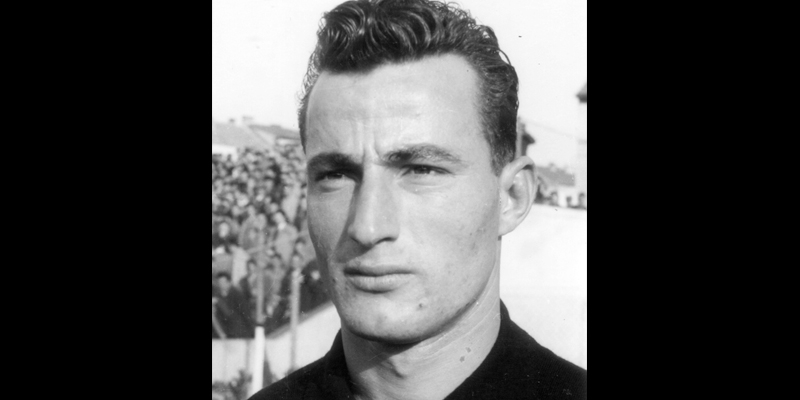
Ante Jurić, former Hajduk and national team goalkeeper, has passed away aged 80, after a serious illness.
His first footballing steps were taken on the long-gone beach at Stinice. There in the shallows, he would leap and catch thrown balls just as a goalkeeper might. It was his father, once the goalkeeper for Omladinac of Vranjic, who noticed the boy's aptitude for catching balls. He signed him up for the unregistered team Jedinstvo, hailing from the Split suburb Kopilica. When they won Split's Divlja Liga (literally the Wild League), the time came for the boy to join the club now known as Split, which then operated under the name Arsenal. Two years later, now a young man of twenty, he made the step up to Hajduk, where he would remain for ten years, between 1955 and 1965.
Ante Jurić was born in Split on February 1, 1934. He managed to score a goal in his 243 appearances for Hajduk. He was a member of the national team of the former Yugoslavia. He successfully prevented the White ship from sinking into the Second Division in the difficult period during the 1960s when this threat loomed large more than once. May it never come again...
His Hajduk debut took place on December 4 1955 in Belgrade, in the 2:0 defeat against BSK. In those days, the Hajduk shirt was worn by many who would pass into legend: Frane Matošić, Vukas, Luštica, Rebac and others. There were many coaching changes in this period. Ante Jurić began under Frane Matošić, who was player-coach for a while. He then played under Ljubo Benčić, Ive Radovniković, Milovan Čirić, Leo Lemešić, Florijan Matekalo, Lenko Grčić, Krešimir Arapović and Ozren Nedoklan. Coaches and players alike came and went in this period, due to sub-par results. Indeed the club had lost focus and the main lack was an overall strategy, a clear direction. Jurić liked to say that Hajduk only recovered from this crisis thanks to the fans' loyalty.
After his Hajduk career was over, he spent a half-season in the Second Division with Split. He then retired, but was lured between the sticks again at a friend's behest. This was the late Ante Valenta, who signed him as player-coach for the lower league Uskok of Klis. After gaining promotion into the Dalmatian League (the third tier of competition), he finally retired for good, aged 39.
Ante Jurić earned his one cap for the senior national team of Yugoslavia on April 26, 1959 in Basel. Aleksandar Tirnanić called him up for the International Cup of Dr. Gere, in which Yugoslavia beat Switzernald 5:1. His performance was judged as very good. His playing style earned him the moniker "Rubber keeper."
His championship debut went all but well, against Vojvodina in Split. In his own proverbial back yard, he took the ball out of the net six times. Vojvodina won in Split 6:1, a disaster. But this only awakened the spite in him. He urged himself onto better performances and even hoped for the national team. Many considered this an impossibility, but Ante Jurić proved that nothing is impossible in sports. He managed to reach the national team, and was the league's best goalkeeper for several seasons.
Vojvodina was also the adversary in his most cherished memory from the pitch. The occasion was the 1963 Cup semi-final, played in Novi Sad. Hajduk took a 2:0 lead, but then Ivo Bego was sent off. Multiple player injuries followed and the final score of 2:2 was considered quite lucky. Extra time seemed to drag on forever, but the result did not change and the match went to penalties. The hosts shot first. All five of their shots were very well-taken, strong and precise. But Jurić miraculously saved three penalties! This was his "retribution" for the six goals he conceded eight years ago in Split, in his Hajduk debut. What is more, he asked to be included as a penalty taker. His wish was granted. He shot and scored. That shot and that goal truly meant that luck had gone full circle.
He never forgot the team spirit and camaraderie from the Hajduk dressing room of that time. "We were a generation full of charm, spirit and joy," he said.
The memorial service will be held on Thursday, at Split's Lovrinac cemetery, starting at 3:30 PM.